FAQs about the Carpathia
Finding Inspiration in Every Turn
General FAQs about the RMS Carpathia
Who built and owned the ship?
It was built by Swan Hunter & Wigham Richardson in Wallsend, near Newcastle upon Tyne, England, and owned by the Cunard Line.
Where did the name come from?
The ship was named after the Carpathian Mountain range in Central Europe.
How long did the Carpathia operate?
The Carpathia's maiden voyage as the SS (Steamship) Carpathia took place on May 5, 1903, traveling from Liverpool to Boston and New York City. She became the RMS Carpathia when she began carrying mail and then rescued the passengers of the Titanic. She again changed function and became the HMT Carpathia during the First World War, when the Carpathia served as a military transport before being sunk by a German U-boat in 1918.
How big was the ship?
It measured 558 feet (170 meters) long, had a gross tonnage of over 13,500, and initially carried about 1,700 passengers. After 1905 renovations, its capacity increased to 2,550 passengers.
Where did the Carpathia travel?
The Carpathia connected Rijeka (Fiume), Croatia; with Italian ports of Trieste, Naples, Genoa, Palermo, and Messina; and New York from 1903 to 1915. In 1915, she left Mediterranean service for the last time and was transferred to the Liverpool–New York route.
How did the Carpathia find out that the Titanic sinking?
On April 11, 1912, the Carpathia began her voyage from New York (USA), to the Mediterranean ports of Messina, Palermo, Naples, Genoa, and Trieste (Italy), with her final destination in Rijeka (Croatia), On April 15, the Carpathia was steaming east toward Gibraltar, deliberately traveling far south of the typical, dangerous North Atlantic ice fields to ensure a comfortable cruise for her passengers, when the wireless operator, Harold Cottam, heard the Titanic’s S.O.S. and C.Q.D. calls. Captain Roston was summoned from his cabin in the middle of the night. He immediately ordered the ship to assist the sinking liner. They set off at full stream through an ice field to reach the Titanic, which was around 58 miles (93 kilometers) away.
Were there other ships that heard the S.O.S. calls of the Titanic?
The closest ship to the RMS Titanic when it sank was the SS Californian, which was roughly 10 to 14 miles away, though its crew failed to realize the severity of the situation or respond to distress rockets. Other ships close by that heard faint signals were the Mount Temple, Frankfurt, Birma, and Parisian.
Wasn't it dangerous for Captain Rostrom to go rescue the Titanic and its passengers?
Yes, definitely. By turning the Carpathia toward the Titanic and ordering the ship to proceed at maximum speed through an ice field, Captain Arthur Rostron took an extraordinary risk, knowingly exposing the ship and her crew to serious danger. He put the rescue of the Titanic’s passengers ahead of the normal rules and precautions governing safe navigation. His decision involved deliberately accepting a level of risk that could have endangered both the Carpathia and everyone aboard.
How fast did the Carpathia travel to the site?
Captain Rostron pushed the ship past its top normal speed of 14.5 knots to over 17 knots by cutting cabin heating and diverting extra steam to the engines.
How did the Carpathia find the Titanic and its survivors?
Under the command of Captain Arthur Rostron, the ship received the Titanic’s distress signal at 12:20 AM on April 15, 1912, while sailing from New York to the Mediterranean.
Did the Titanic send out the correct coordinates for their rescue?
No, Jack Phillips, the British Marconi wireless operator aboard the Titanic, transmitted incorrect coordinates, approximately 20 miles southwest of the Titanic’s actual position. Harold Cottam, the wireless operator aboard the Carpathia, received these messages. The Carpathia raced toward the incorrect location, while ocean currents carried the Titanic’s lifeboats onto the route along which the Carpathia was traveling, approximately 20 miles before Phillips’ reported position.
Because of the incorrect coordinates, did it take the Carpathia longer for them to find the survivors?
Actually no, the Carpathia found the survivors earlier than expected, approximately 30 minutes earlier. The survivors were spotted along the route Carpathia was taking toward the position it had received from the Titanic, but they did not know that the position was incorrect. At that time, nobody knew that the coordinates were wrong; this was only established later.
How many people did it rescue?
The crew rescued a total of 716 survivors from the Titanic from the ice-filled waters into 20 lifeboats. Four of them died aboard the Carpathia. Their funeral services were held aboard the Carpathia, and their bodies were committed to the ocean during the funeral ceremony. The final number of survivors brought safely to New York was 712.
Where did the Carpathia go after the rescue?
Captain Rostron made the decision to reverse course and return to New York rather than continue to Rijeka (Fiume), Croatia, which at the time was part of Austria-Hungary.
Where was the Olympic, the Titanic’s sister ship at that time?
The RMS Olympic was approximately 500–600 km (270–325 nautical miles) from the Titanic when she received news of the disaster. She headed toward the Titanic to assist but eventually turned back after it was determined that she would arrive many hours after the Titanic had sunk.
Where is the Carpathia today?
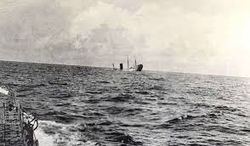
During World War I, while serving as an Allied troop transport, it was torpedoed three times by a German submarine (U-55) off the southern coast of Ireland on July 17, 1918.
Were there casualties when it sank in 1918?
Yes, five crew members lost their lives in the attack, but the rest of the people on board survived.
Where is the wreck today?
Off the coast of Ireland. The wreck was discovered in 2000 by marine author and explorer Clive Cussler. It lies upright at a maximum depth of approximately 153 meters (500 feet), about 120 miles (190 kilometers) west of Fastnet, Ireland.
Did anything change after the Titanic/Carpathia rescue mission?
The sinking of the RMS Titanic and the heroic rescue by the RMS Carpathia in April 1912 completely transformed international maritime law, safety rules, and radio communications at sea. The disaster exposed massive flaws in maritime law, which prompted immediate, sweeping legal changes worldwide:
-
Immediately, laws changed to mandate enough lifeboat spaces for every single person on the ship.
-
Mandate to design taller watertight bulkheads and double hulls to stop water from spreading quickly.
-
24-hour radio watch: The disaster happened partly because a nearby ship's radio operator went to sleep. New rules required constant, round-the-clock radio monitoring on passenger ships, backed by emergency auxiliary power supplies.
-
The Radio Act of 1912: Passed in the United States, this law required radio operators to be licensed and gave official priority to distress signals so they would not be jammed or ignored.
-
International Ice Patrol: Established in 1914, this organization monitors icebergs in the North Atlantic shipping lanes and warns passing vessels of dangerous field conditions.
-
Standardized signals: Rocket flare colors and codes were unified globally so that white or red pyrotechnics unambiguously meant distress rather than routine company communication.
What is #BeCottam?
#BeCottom is a social media campaign where we invite members of the Carpathia community to be part of the movement that recognizes everyday people for their selfless actions! Submit your stories (short videos, 3 mins max) of people that you would like to highlight. Email us: carpathiaprods@gmail.com.
 |  |  |
|---|---|---|
 |  |  |
 |  |  |
 |

Proudly presented by


