CARPATHIA
Feature film

Production Status: In Development
Genre: Historical Drama
Tagline: When the world turned away, the Carpathia turned back—the only ship that came to Titanic's rescue.
Logline: As the Titanic sinks into the North Atlantic, the captain of the Carpathia risks everything by steering his ship into deadly ice fields, facing panic, mutiny, and impossible odds to try to save the survivors, who may already be lost.
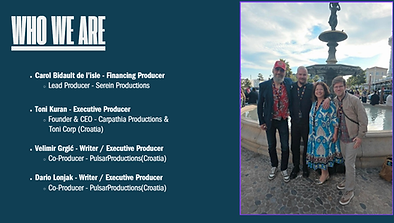
Writers: Velimir Grgić & Dario Lonjak | Co-writer Toni Kuran
Producer: Carol Bidault de l'Isle (France)
Executive Producers: Toni Kuran, Velimir Grgić & Dario Lonjak
Countries of production: FRANCE, IRELAND, CROATIA, ITALY, SWEDEN
Duration (in minutes): 100
SYNOPSIS:
In the freezing darkness of the North Atlantic, moments after the Titanic disappears beneath the surface, lifeboats scatter across a black, silent ocean. Oil lamps illuminate desperate figures in the water—men and women clinging to wreckage, crying out for help. In Lifeboat No. 6, American socialite Margaret “Molly” Brown openly defies the embittered quartermaster Robert Hichens, demanding they turn back to rescue survivors. Nearby, the half-submerged Collapsible A drifts like a broken raft, its passengers standing in icy water, watching people die beside them.
Hours earlier aboard the passenger steamer Carpathia, Captain Arthur Rostron presides over what should be an uneventful crossing. When his exhausted telegraphist Harold Cottam receives and passes on the Titanic’s SOS, Rostron makes an immediate, irreversible decision: he turns the ship around and drives her at full speed straight into iceberg-filled waters.
To gain every possible knot, Rostron shuts down heating and electricity, pushing the engines—and his crew—to their limits. Panic spreads among passengers. When third-class quarters are displaced to prepare space for survivors, fear hardens into resentment. Rumors of the captain's madness and recklessness ignite a mutiny fueled by class tension and the belief that no one could still be alive in such cold water.
At sea, survival turns brutal. Bodies are thrown from rafts not out of cruelty but to keep moving, to fight hypothermia, and to stay alive. Fifth Officer Harold Godfrey Lowe, commanding Lifeboat No. 14, is the only officer to return to the wreck site, rescuing the last survivors from the water.
At dawn, Carpathia reaches an empty sea. Just as Rostron loses hope, the rising sun reveals white shapes on the horizon—not ice but Titanic’s lifeboats.
The rescue lasts for hours. Babies are hauled aboard in sacks, the frozen are lifted by ropes, and the living are separated from the dead. Molly Brown is among the last to leave her boat, helping others before herself.
When Carpathia finally returns to New York, tens of thousands wait in silence. In the aftermath, Rostron refuses personal glory, Molly Brown transforms tragedy into lifelong activism, and the survivors carry with them the weight of those they could not save.
CARPATHIA is a tense historical thriller about moral courage under impossible pressure—about leadership, conscience, and the cost of choosing to act when doing nothing would be safer.
CARPATHIA
Companion documentary
CARPATHIA, the companion documentary, will follow closely the story depicted in the feature film. It is a tense historical story, meticulously researched, about moral courage under impossible pressure—about leadership, conscience, and the cost of choosing to act when doing nothing would be safer.
The picture below show the survivors of the RMS Titanic on a lifeboat, viewed from the deck of the RMS Carpathia.

The picture below was taken on the RMS Carpathia of survivors of the RMS Titanic.

The picture below shows the thousands of people, photographers, loved ones waiting to see if their loved ones survived the sinking of the RMS Titanic
.jpg)
The picture below was taken of the officers of the RMS Carpathia, including Captain Rostron and telegraphist Harold Cottam. Were it not for these 2 men that chose to do the right thing, not only saving over 700 lives, but changing shipping forever.

The picture below was taken on May 29, 1912, when the RMS Titanic survivor Margaret "Molly" Brown presented Captain Arthur Rostron, RMS Carpathia with an inscribed silver trophy cup, known as the Carpathia Loving Cup, on behalf of the Titanic Survivors Committee to honor his heroic efforts in rescuing over 700 survivors from the sinking of the Titanic.
